
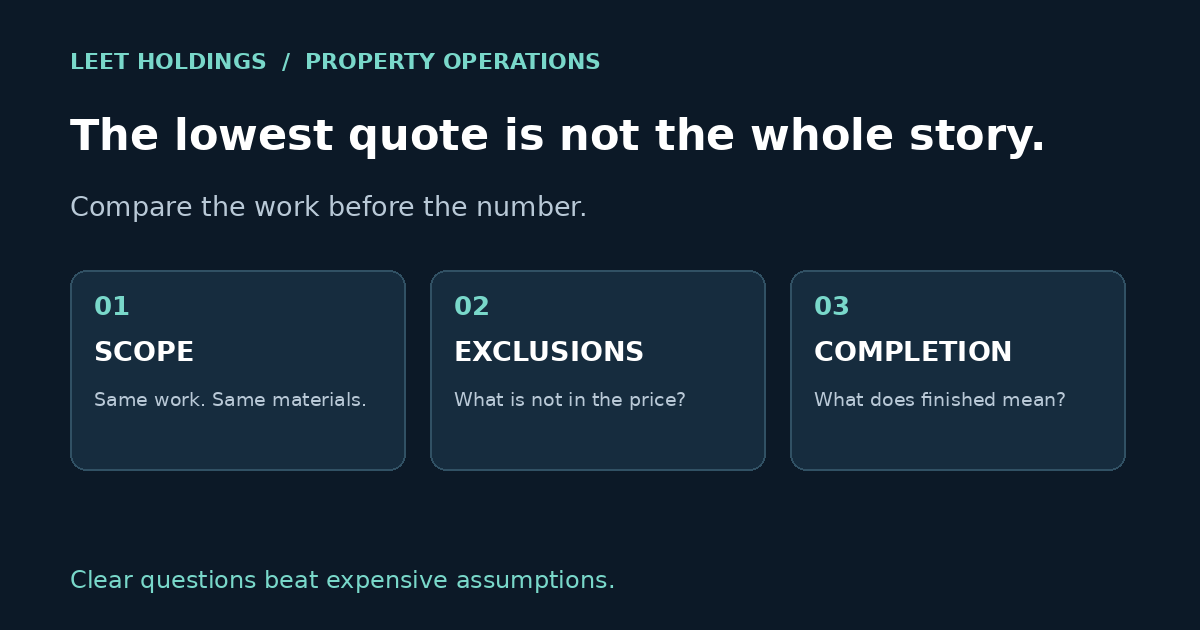
Three quotes arrive. One is attractively short. Another lists enough detail to qualify as weekend reading. The third says “as discussed.” Sorting them by price is easy. Establishing whether they describe the same job is the part that deserves a chair and a highlighter.
This guide offers a practical comparison method for property owners planning work. It is not a recommendation of a contractor, a contract template or a report of Leet Holdings projects. The goal is to turn vague differences into questions you can resolve before making a decision.
Give everyone the same starting point
The Federal Trade Commission recommends multiple written estimates covering the work, materials, expected completion and price. It also advises asking about large differences instead of automatically choosing the lowest estimate. That is a useful foundation; the comparison still needs a common brief.
Write down the outcome you want, the areas involved and any known constraints. Send the same information to each bidder. If a site visit changes the understanding of the work, circulate the relevant clarification to everyone still bidding. Otherwise, one contractor may price the job you described on Monday while another prices the version you discovered on Thursday.
Keep observations separate from diagnosis. “A stain appeared below this window after rain” is information. “Replace the window because it caused the leak” may be an untested conclusion. Ask what assessment is needed before a repair scope can be dependable.
Build a comparison sheet that tolerates unanswered questions
Use one row per work item and one column per quote. Copy the contractor’s actual description or cite the page; do not improve ambiguous wording on their behalf. Add a fourth column for the clarification you need. Helpful row headings include:
- Work boundary: which surfaces, rooms, components or areas are included?
- Preparation and protection: what happens before installation, and what existing finishes remain?
- Materials: what product or performance description is priced, and which selections remain undecided?
- Exclusions: what work, disposal, access equipment or associated task is outside this quote?
- Completion evidence: what inspection, demonstration, documentation or cleanup is included?
Mark unclear entries “not stated,” not “included.” An empty cell is a question, not a bargain. This worksheet is an organizational aid, not a professional assessment of whether the proposed work is technically adequate.
Do not silently turn an allowance into a fixed price
When a quote uses words such as allowance, provisional, estimate or optional, ask the contractor exactly how that item is treated. Request the amount included, the assumption behind it and the process for agreeing any difference. Do not assume different businesses use these labels identically.
Consider a hypothetical painting project. One quote describes surface preparation and the finish system. Another says only “paint room.” Even without seeing a price, you already know the documents are not equally specific. Ask the second contractor to clarify rather than guessing that the shorter description includes the longer one.
For a genuine alternative, keep the base scope and the optional upgrade separate. A comparison sheet should make a choice visible, not bury it inside an attractive total. Avoid adding your own invented cost to an exclusion just to produce a tidy ranking; obtain a priced clarification or leave the difference unresolved.
Verify the business separately from the bid
The Charlotte County consumer guide distinguishes business registration from contractor licensing and advises checking requirements for the particular trade. Its contract checklist also highlights completion, cleanup and warranty details. Those are useful questions beyond its local jurisdiction; its permitting rules are not a substitute for the rules where your property sits.
Verify applicable credentials with the relevant licensing authority and ask the local building department about the proposed work. Match the business and individual details to the documents you receive. A polished logo is not a credential check. Ask for appropriate insurance evidence and references rather than relying on the phrase “licensed and insured.”
Make the finish line and changes explicit
Ask what must happen for the job to count as complete, who provides the agreed records and how unresolved items will be handled. Identify expected timing and dependencies rather than treating an anticipated date as an unconditional promise.
Before work starts, clarify how proposed changes will be described, priced and approved. Keep the accepted scope and later agreed revisions together. For significant or unfamiliar terms, obtain appropriate professional advice before signing; this article does not interpret your contract or determine your legal rights.
Once work is complete, connect the resulting documents to a useful property maintenance record. If you have a property or partnership to discuss, contact Leet Holdings. The cheapest-looking quote can still be a reasonable choice—but first make sure you are comparing the same job, not three different interpretations of “included.”
Sources checked November 3, 2026. General planning guidance; not legal, engineering or procurement advice. Recheck licensing and local requirements for each actual project.