
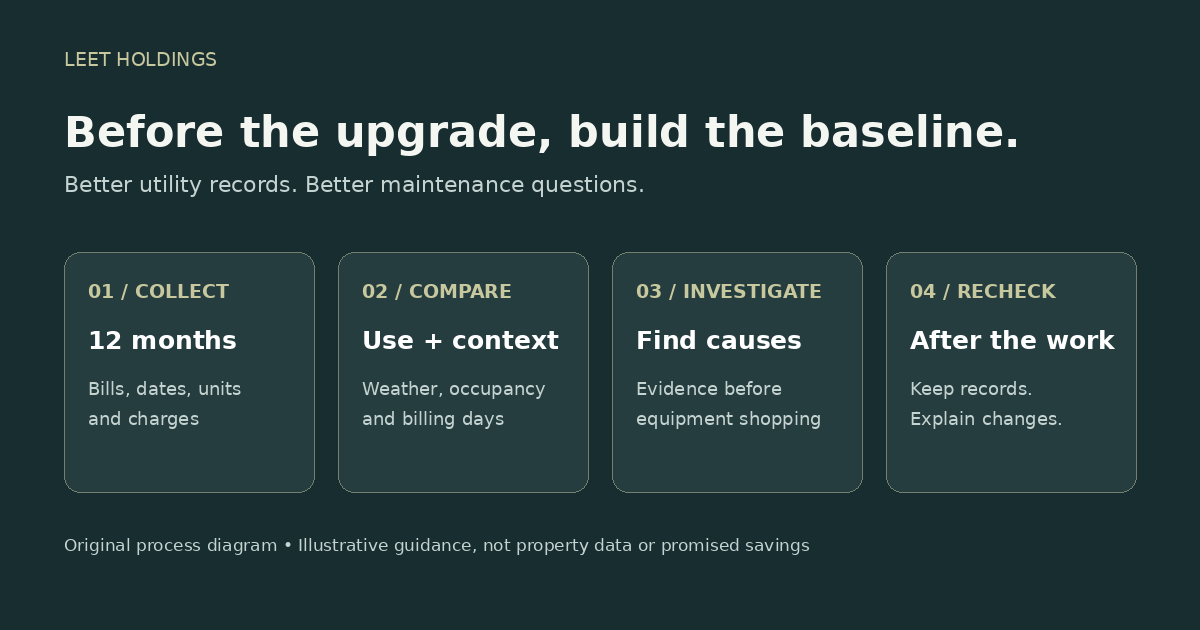
A surprisingly expensive utility bill can inspire an ambitious shopping list: new windows, new air conditioning, perhaps a gadget with a heroic savings claim. Before spending money, build a record of what the property actually uses. A bill tells you what was charged. A useful baseline helps you ask why.
For an owner reviewing operating costs, or a buyer examining records supplied with permission, the goal is straightforward: separate consumption from price, add the missing context and identify the questions worth paying a professional to answer.
Start with a complete year, not a convenient month
Gather twelve consecutive months of electricity, water and any other energy bills that serve the property. Preserve the original statements and record the service address, billing dates, units consumed and charges. Identify missing periods instead of quietly filling them with guesses.
There is a reason for looking beyond one season. ENERGY STAR’s Home Energy Yardstick uses twelve months of actual energy use and accounts for weather, home size and occupants when comparing homes. It also warns that a basic comparison does not replace a professional assessment.
For a rental, add occupancy and turnover context without collecting unnecessary guest details. For a multi-residence property, establish which meter serves which space and whether shared equipment is included. Two addresses and one meter deserve a question before they become two confident budgets.
Keep consumption and money in different columns
Record electricity in kilowatt-hours and water in the units printed on the bill. Keep each fuel or service separate. Note billing-period length, fixed charges, adjustments and whether the utility identifies the reading as actual or estimated. Do not compare gallons with cubic feet as if the numbers mean the same thing.
A simple first-pass measure is consumption divided by the number of billing days. That can make a short month and a long month easier to compare, although it does not adjust for weather or occupancy. Keep both the original total and the daily figure so someone else can check the arithmetic.
Budget billing needs particular care. The Federal Trade Commission explains that spreading payments across the year does not itself reduce the annual cost. A tidy monthly payment is not evidence of tidy energy use.
Add context before diagnosing the equipment
Mark major changes: vacancy, a different occupancy pattern, an equipment replacement, a service visit or a known leak. Ask whether the use of the building changed during the period. A formerly vacant home and a busy vacation rental are unlikely to have identical operating patterns.
The U.S. Energy Information Administration describes how electricity consumption varies with region and housing type, and how weather affects heating and cooling use. National averages can provide background, but they should not be pasted into a property budget and presented as that building’s expected result.
For a more careful weather comparison, an assessor may use heating or cooling degree days. EIA’s degree-day explanation describes these temperature-based measures. Do not label a spreadsheet “weather-normalized” merely because it has a weather column.
Treat unexplained water use as a maintenance clue
A water-use increase deserves a look at both operations and possible leaks. EPA WaterSense recommends comparing bills with the same month in the prior year and describes checking a meter before and after a two-hour period when no water is being used. A changed reading can indicate a leak.
Coordinate any check with occupants and the utility’s access rules. Account for irrigation, appliances and other legitimate automatic uses. Do not shut off essential systems or open equipment you are not qualified to handle. If the result is unclear, ask the utility or a qualified plumber to investigate. Record the observation, repair and follow-up reading rather than declaring the issue solved because someone tightened something.
Turn the baseline into a better scope of work
Bring the bills, equipment information and specific concerns to a qualified assessor or contractor. Ask what they will inspect, what measurements are included and what written recommendations you will receive. The FTC notes that utilities may offer assessments or referrals; availability and eligibility need checking locally.
For any proposed upgrade, ask which assumption supports the savings estimate: current equipment condition, usage, tariff, weather or a standard test. Request the installed cost, relevant maintenance requirements and the limits of the estimate. Keep comfort and reliability in the discussion. A lower number on paper is less impressive if the underlying problem remains.
Measure again after the work
Save the completion date and invoice, then continue the same recordkeeping. Compare suitable periods and explain changes in occupancy, weather and billing. One cheaper bill can be encouraging without proving that a particular repair caused the reduction.
This approach produces something more useful than a shopping list: a traceable operating record and a clearer next decision. Explore Leet Holdings’ approach or start a property or partnership conversation. Our property-introduction guide explains how to organize an initial overview.
Sources checked November 1, 2026. General property-operations guidance; no savings, investment return or equipment-performance guarantee. This article does not report utility costs or results for a Leet Holdings property.